Stories, Memory, and the Landscapes We Carry: A Conversation with Mary Novakovich
 Hello Readers!
There’s a certain magic in the air when the scent of freshly sharpened pencils and crisp new books fills your nostrils, instantly transporting you back to the carefree days of childhood. These scents, laden with the promise of new beginnings and the quiet excitement of stories yet to be discovered, hold a special place in our hearts. As an author, I often find myself drawn to these same feelings when I sit down to write. Perhaps that’s why certain smells and sensations stay with us. They remind us that stories, whether read or written, are never far from who we are.
Nothing thrills me more than sinking into a genuinely great book. I wanted to share with you an excellent one, recommended by my dear friend, Dr. Vera Dragisich/ University of Chicago, who reminded me of why stories matter so much. British author, Mary Novakovich, crafts a poignant mosaic of history and identity in her book: My Family and Other Enemies. With the precision of a travel writer that she is, and the soul of a memoirist, Novakovich, a fellow Serbian, takes us singlehandedly through Croatia’s virtually untouched hinterland—Lika, that brims with authenticity, rugged landscapes, enduring traditions, and the quiet resilience of its people. I was immediately drawn by Novakovich’s poignant ability to weave history, memory, and place into her mesmerizing book. My Family and Other Enemies reminds us how much our identity is bound to the landscapes and spaces of our ancestors.
What begins as a journey with her mother becomes a layered exploration of family, legacy, and historical reckoning. She does not flinch from the atrocities committed in WWII or the disillusionment of the Yugoslav Wars, even though her father was part of the trusted resistance I write about in No Bread Tomorrow during WWII. Nor does she romanticize her family’s experiences. Instead, Novakovich offers readers a raw and brave excavation of truth, delivered with stupendous grace, and sensory richness. Her prose carries the scent of meze and wild sage, the burden of crumbling homesteads, and the stillness of the mountains. Through intimate vignettes; meals shared, secrets confessed, and ghosts unearthed, she renders a portrait of a region easily dismissed or misunderstood.
It is a testament to the beauty of the Serbian people still living in this pocket of the world, and fortuitously, I had the pleasure of interviewing Mary for this newsletter. I am delighted to share her insights with you here:
1.) Your book is deeply personal. How did writing My Family and Other Enemies shape or reshape your understanding of your mother and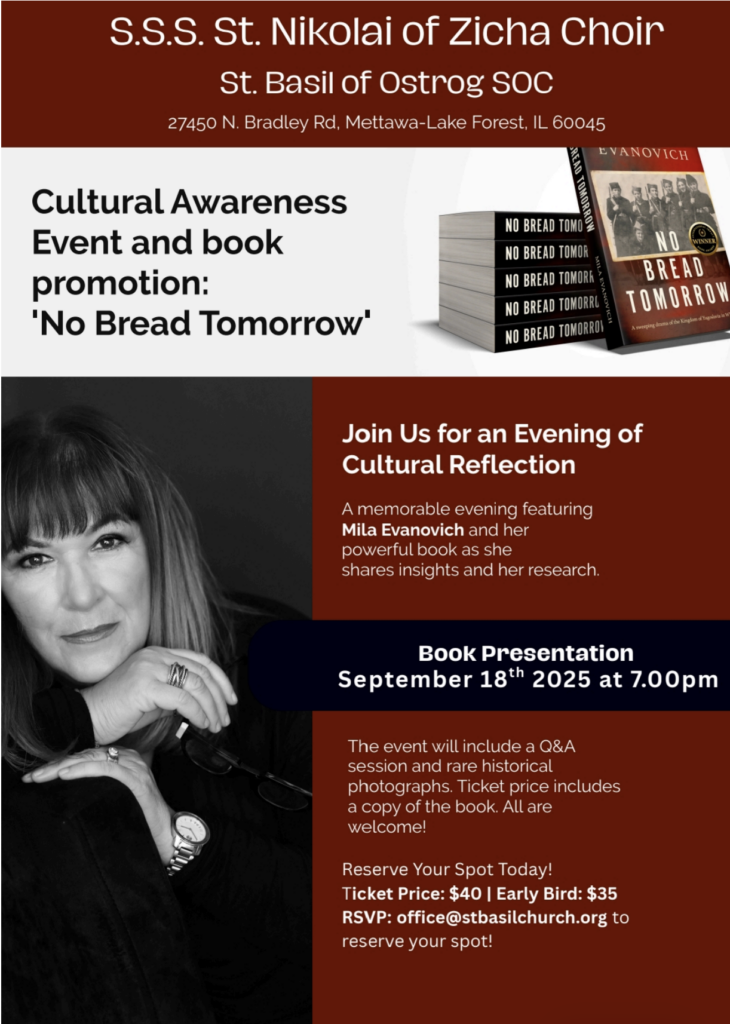 your extended Serbian family?
As the book clearly and at times painfully shows, my mother and I had a very rocky time during that 2009 road trip. Yet the stories I eventually managed to get out of her filled me with such pity and compassion, especially those involving her mother, and I feel privileged that I was able to tell them. It was also a privilege to hear stories from other family members and friends – that generation is rapidly dying out, and it’s important to get their stories while it’s still possible.
2.) On an emotional level, could you describe how you felt after revisiting Lika with your mother?
To be candid, it was really hard work, and I regret that we spent so much time arguing, especially as her dementia is now very advanced. I wish we had been able to have more civilised conversations – there were so many questions that went unanswered, and now I’ll never know.
3.) How did your brothers and other family members respond to your decision to include certain painful memories in your book?
My brothers were very supportive. Even though I’m very frank in the book about my mother’s faults (and mine too!), people who know my mother knew that I couldn’t whitewash her character. Oddly, my cousins, whose family stories I told, never actually told me what they thought of the book. Maybe they haven’t got round to reading it. If I had caused some sort of rift or commotion, I’m sure I would have heard about it by now in the family grapevine.
4.) I attended the Historical Novel Society Conference in Vegas this summer. Surprisingly, three writers asked me about Plitvice Lakes, Croatia. I recommended your book, and their conversations had me wondering if Croatia’s more popular coastal destinations often overshadow Lika. Do you think international travelers tend to misunderstand the region, especially when it comes to something as magical as Plitvice Lakes?
Lika, apart from Plitvice, is certainly overshadowed by the Adriatic coast and the islands. To many travelers to Croatia, Plitvice is another destination to be ticked off the list, and I imagine that most visitors will have little or no knowledge of the region surrounding it. They probably don’t even recognize the name Lika. It’s such a vast and diverse region. While much of it remains depopulated (both because of the 1990s war and a general rural exodus), there are parts of Lika that are undergoing a resurgence, specifically in adventure tourism in the western areas around Otočac and the Gacka Valley.
5.) You write about the Ustaše atrocities and the post-war displacement with unwavering honesty. Did you encounter any resistance in telling these stories, particularly within contemporary Croatian or diasporic communities?
Luckily, I haven’t had any adverse feedback from readers about what I had written about the Ustaše. I know that there’s a certain amount of revisionism within some Croatian communities, but nothing has been directed my way.
6.) Your book is a blend of memoir, travel writing, and oral history. How did you navigate and structure such layered material?
It wasn’t easy. I wanted a balance between travelogue and memoir, while at the same time writing about a history that’s hardly known. I was a bit worried that my stories would be too personal and wouldn’t register, but then I received so many messages from readers who told me how much their own family histories chimed with mine.
7.) Were there any stories or moments you had to leave out that you wish you hadn’t?
You always leave things out, and often for the better. At the same time, it’s useful to have some more stories up your sleeve for when you write extended features to publicize the book, as I’ve done.
8.) You have quite the colorful cast of Serbs and family in your book. I was particularly drawn to Gojko. I cannot imagine how his death impacted you. Is it any easier to talk about him now?
I miss Gojko so much. Not only that, but I miss that period in my life when I spent so much time in Lika with him. It was such a special time, and I always treasure it.
9.) In my own research, I ached at seeing so much of what we today know as ancestral trauma. Yet, there is still little written about it in the Balkans. How do you see your My Family and Other Enemies contributing to conversations about memory and ancestral trauma?
I’m not sure about how much of a contribution my book has made. But it’s brought about discussions on how much the younger generations need to know about our history, yet come to terms with it so that we don’t end up keeping old hatreds and misconceptions alive.
 10.) What do you hope readers, especially those unfamiliar with our Yugoslavian history, take away from your book?
Many readers told me of the connection they felt with my story, how my family resembled theirs, how the book brought back memories of food and good times. Others who had no idea of our history told me how gratified they were to discover some of it. And also, those who had no historical connection with the region still found so many parallels with their own stories – mother/daughter relationships, being a refugee, holding tightly on to a culture and its food, and the importance of family.
Here’s Mary Novakovich’s Linktree link to all the various ways people can buy her book. It’s very UK-focused, but there are links to Amazon in the US and Barnes & Noble. https://linktr.ee/marynovakovich
Thank you so much for your time, Mary!
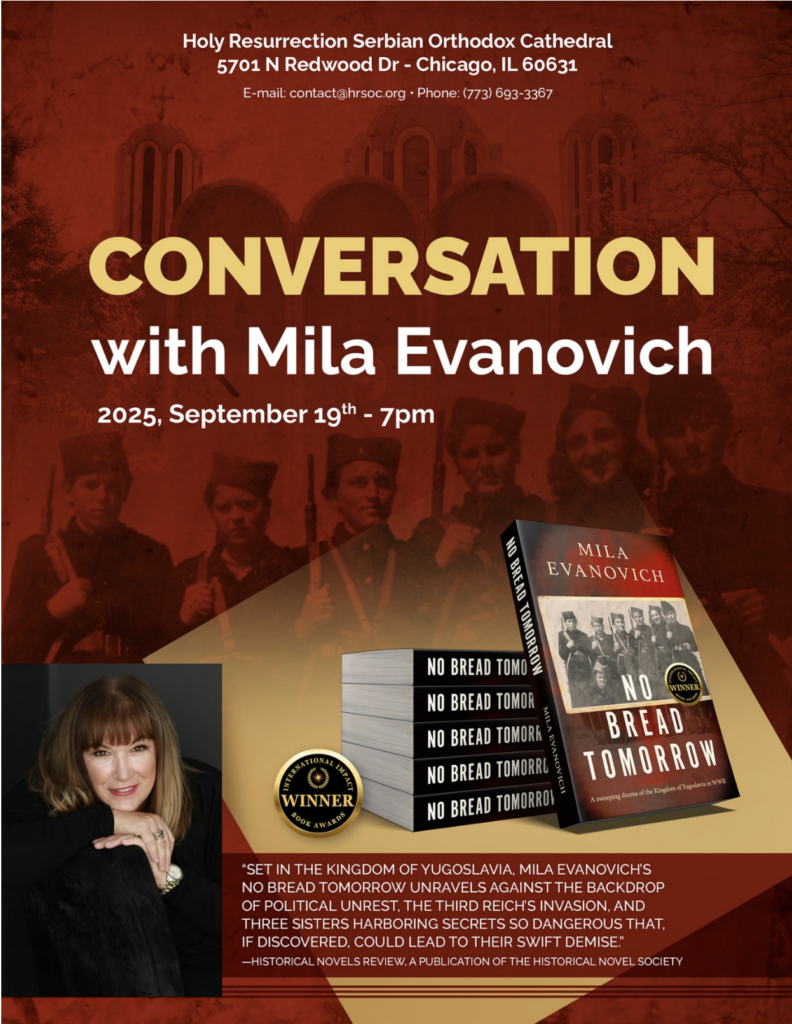
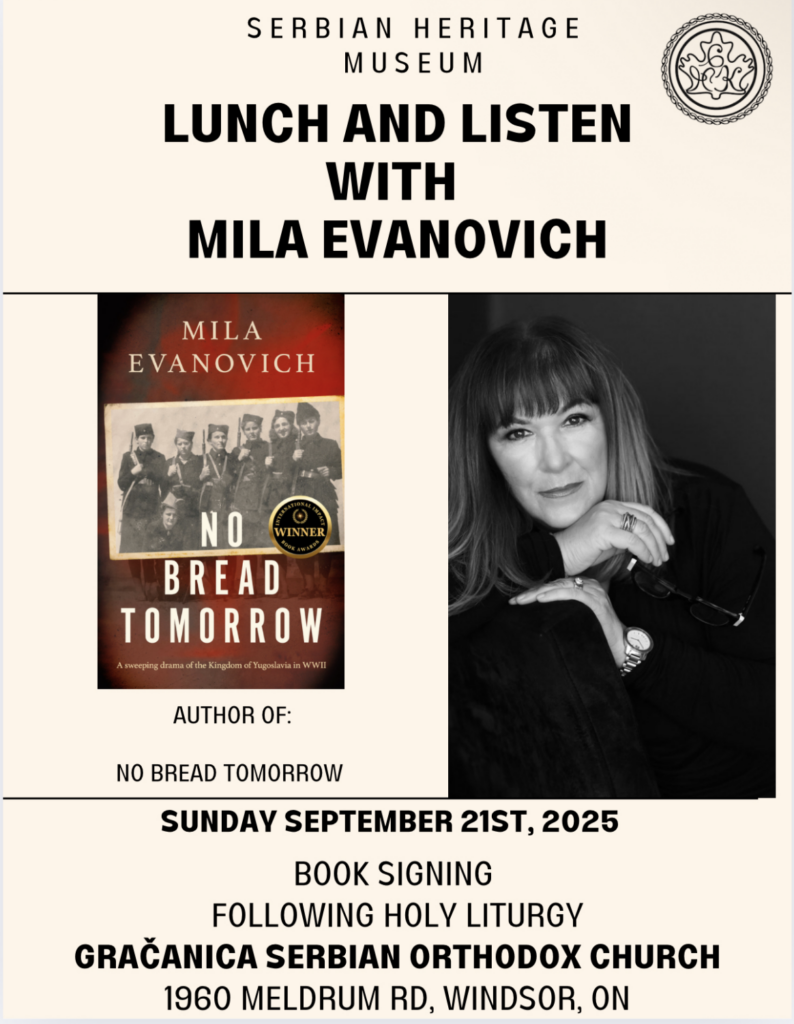
It was such a joy traveling to Pennsylvania for book events with my daughter, Kaitlyn this past May. We met and reconnected with so many wonderful people, and as always, our time there felt far too short. I would especially like to extend heartfelt thanks to the energetic Serbian kolo sisters, whose tireless efforts behind the scenes always bring such warmth, beauty, and spirit to each gathering. Excitedly, I have included below several of the book events in September where I will be speaking about how No Bread Tomorrow came about, the research that never made it into the book, as well as a peek into my upcoming novel. It all starts on September in Lake Forest, Illinois… and I would absolutely love to see you there!
Until then, enjoy the waning days of summer.
Love,
Mila